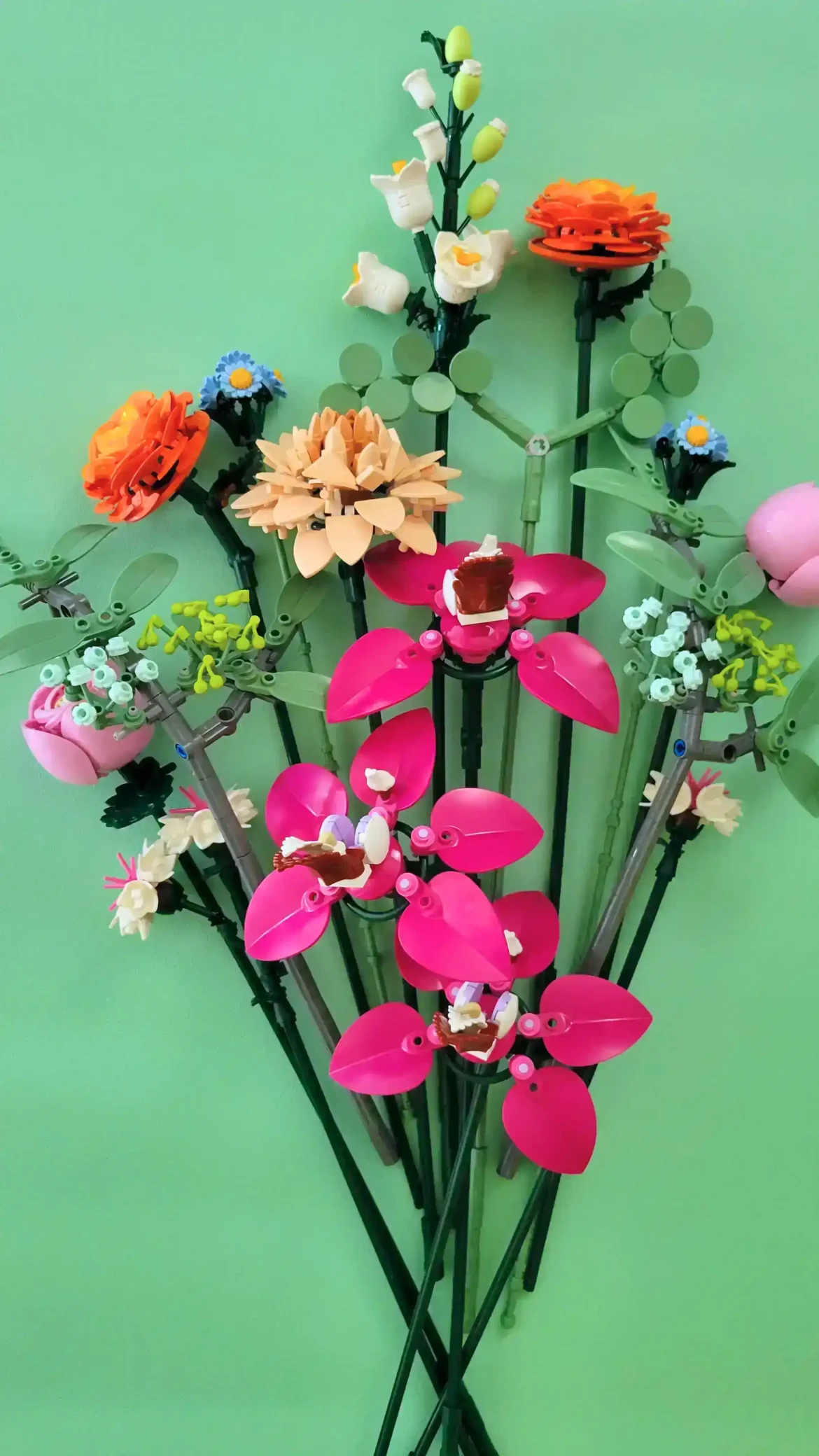
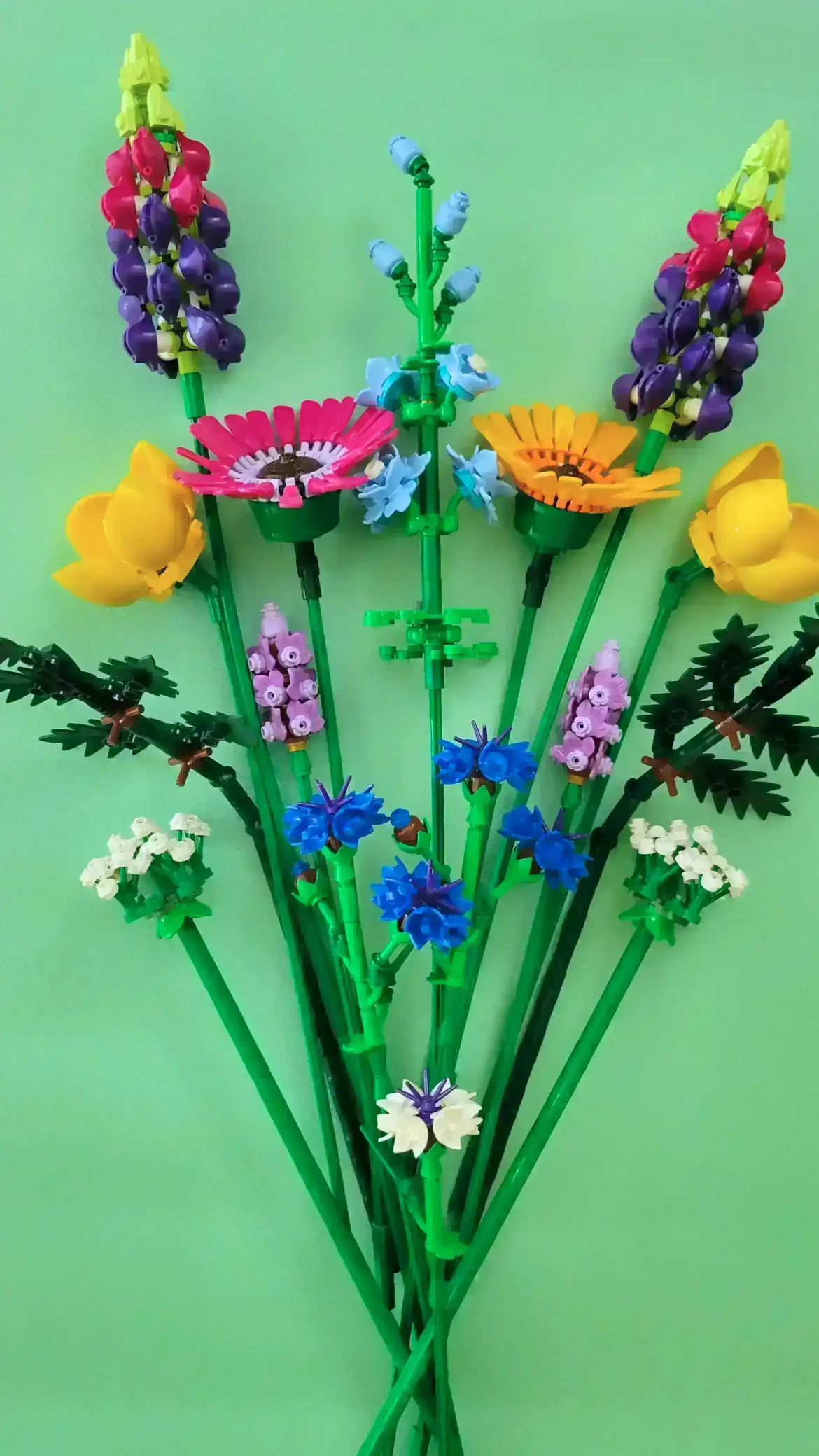
Does floral foam damage LEGO Botanicals? Over the last few years, multiple LEGO collectors have reported stem damage after long-term contact with floral foam, raising concerns about whether this popular florist tool is safe for LEGO flower displays.
Many LEGO Botanicals collectors use floral foam to keep bouquets upright inside vases and planters. On paper, it seems like the perfect solution. It’s inexpensive, easy to find, and commonly used by florists to arrange fresh flowers.
But over the last few years, LEGO collectors have started reporting something unexpected.
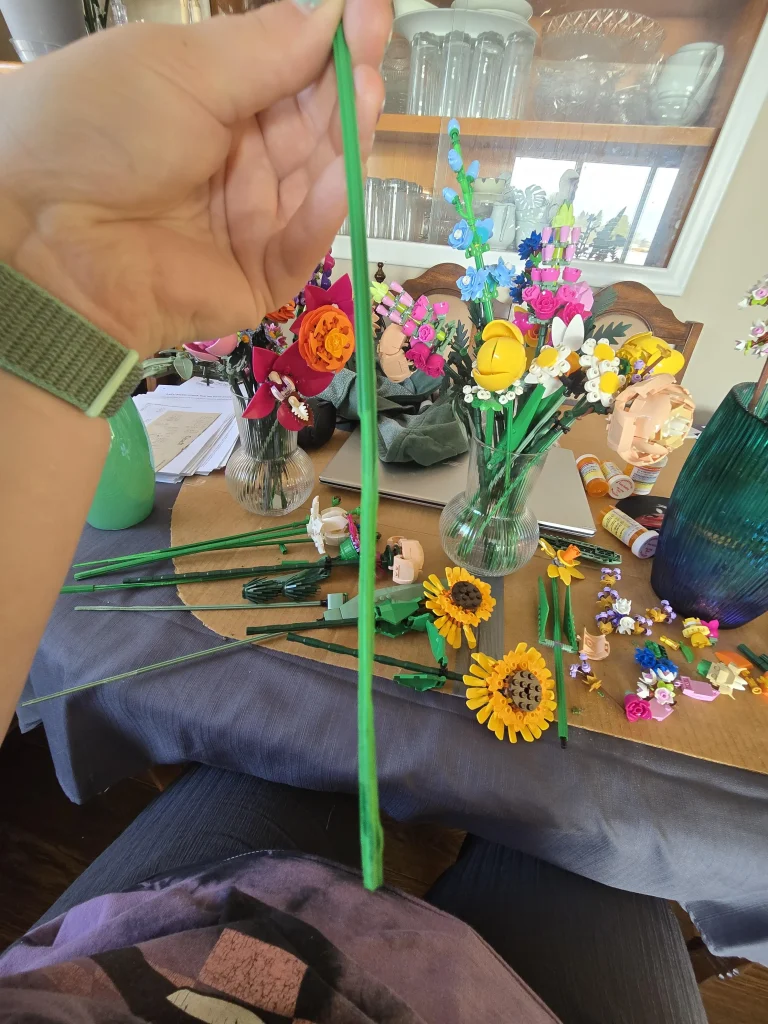
Several members of the LEGO community have shared photos showing damaged LEGO stems after extended contact with green floral foam. In some cases, stems appeared rough, brittle, or partially degraded where they touched the foam.
I started researching this after seeing multiple reports across Reddit, Facebook groups, and LEGO communities. What surprised me wasn’t just the number of reports, but how similar many of them were.
I actually tried floral foam myself before learning about these reports. Even without the potential damage concerns, I hated working with it. The foam was messy, sandy, shed particles everywhere, and quickly became frustrating when rearranging flowers. Every time I moved a stem, it created a larger hole in the foam, making future adjustments harder.
The good news is that there are several safer alternatives to floral foam for LEGO Botanicals, including chicken wire, tape grids, flower frogs, decorative fillers, and sand.
If you’re currently using floral foam with your LEGO flowers, or you’re considering it for a future arrangement, here’s what collectors need to know before inserting another stem.
Some links in this post are affiliate links. If you choose to buy through them, nanibricks may earn a small commission at no extra cost to you. Your support helps keep the blog thriving and blooming.
Table of Contents
What Happened? Community Reports From LEGO Collectors
For years, floral foam has been one of the most common ways people support artificial flower arrangements. Naturally, some LEGO Botanicals collectors started using it too.
The idea makes sense. Floral foam is inexpensive, easy to find, and allows you to position stems exactly where you want them. Unfortunately, several LEGO collectors have reported problems after leaving their stems inserted in floral foam for extended periods.
Across Reddit, Facebook groups, and LEGO communities, collectors have shared photos showing stems that appeared rough, brittle, or partially degraded where they had been in contact with green floral foam. In many cases, the damage wasn’t discovered until months or even years later when the flowers were removed from the display.
One Reddit discussion that caught my attention showed multiple LEGO flower stems with noticeable wear exactly where they had been inserted into floral foam. Other collectors quickly joined the conversation, sharing similar experiences and recommending that builders switch to alternative support methods.
What stood out to me wasn’t a single report. It was how often the same story appeared in different places. Different collectors, different arrangements, and different countries, yet many described similar damage occurring where the LEGO stems touched the floral foam.
I actually tried floral foam myself before learning about these reports. Even if stem damage had never been mentioned, I probably wouldn’t use it again.
The foam was messy, sandy, and constantly shed particles that became trapped inside the hollow LEGO stems. Every time I rearranged a flower, it created a larger hole in the foam. The more adjustments I made, the less support the arrangement had.
Since I regularly create new LEGO flower arrangements and experiment with different recipes, floral foam quickly became more frustrating than helpful. That’s what led me to start testing reusable support methods like chicken wire, tape grids, and flower frogs instead.
But that raises an important question:
Why would floral foam potentially damage LEGO stems in the first place?
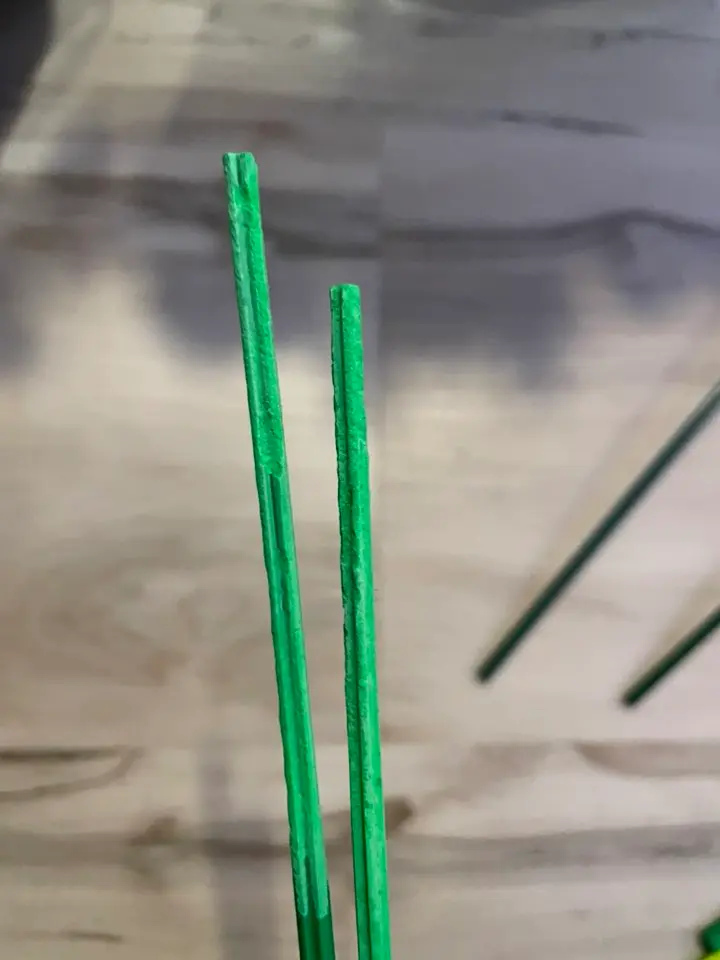
Photos Shared by Collectors
The photos below were shared by LEGO collectors who reported stem deterioration after long-term contact with floral foam. These reports are anecdotal and do not prove causation, but they show why many collectors have started avoiding floral foam for permanent displays.
Does Floral Foam Damage LEGO Botanicals?
Before we go any further, it’s important to be clear about something:
LEGO has not released an official statement saying that floral foam damages LEGO Botanicals. Most of the evidence currently comes from community reports, collector experiences, and discussions shared within the LEGO hobby.
That said, there are enough similar reports that many collectors have started avoiding floral foam for LEGO flowers altogether.
So what could be happening?
Most LEGO flower stems are made from ABS plastic (Acrylonitrile Butadiene Styrene), a durable material designed to last for years. Floral foam, however, was created to hold fresh flower stems, not plastic stems that remain inserted for months or years at a time.
The exact cause of the reported damage is unknown. Some collectors have speculated that prolonged contact with wet floral foam, moisture, or ingredients used in certain foams may contribute to the deterioration they observed, but no official testing specific to LEGO stems appears to be available.
The exact cause is still debated, but many of the community reports show similar warning signs:
- Damage appears where the stem touched the foam
- The affected area becomes rough or textured
- Stems may become brittle over time
- Damage is often discovered after months or years of use
One reason this issue catches collectors by surprise is that floral foam doesn’t appear to cause immediate damage. A LEGO flower arrangement can look perfectly normal for a long time before any problems become visible.
Even if the reported damage isn’t caused by a chemical reaction, floral foam creates another problem that many LEGO Botanicals collectors run into.
Every time a stem is inserted, removed, and reinserted, the foam breaks down a little more. The holes become larger, stems stop sitting securely, and small foam particles can become trapped inside hollow LEGO pieces.
That was actually the biggest issue for me personally.
The foam felt messy from day one. It shed sandy debris everywhere, created permanent holes almost immediately, and made rearranging flowers more difficult every time I adjusted the arrangement. Since I’m constantly creating new LEGO flower arrangement ideas, I quickly realized floral foam wasn’t the right solution for my display style.
For collectors who build a bouquet once and never touch it again, that may not matter.
But for builders who enjoy creating custom arrangements and regularly changing their displays, it’s one of the biggest reasons to consider a different support method.
That leads to another common question:
Is wet floral foam more dangerous than dry floral foam, or are both types a risk for LEGO Botanicals?
Wet Floral Foam vs. Dry Floral Foam: Is One Safer?
One of the most confusing parts of this discussion is that not all floral foam is the same.
In general, there are two main types of floral foam:
- Wet floral foam – The green foam commonly used for fresh flower arrangements. It’s designed to absorb and hold water.
- Dry floral foam – A firmer foam typically used for artificial flowers, crafts, and permanent displays.
When collectors report LEGO stem damage from floral foam, the green wet floral foam is mentioned most often.
Many of the community photos and discussions involve bouquets displayed in traditional green florist foam for extended periods of time. Some collectors believe the combination of moisture, chemicals, and prolonged contact may contribute to the deterioration they observed.
Dry floral foam receives far fewer complaints, but that doesn’t automatically mean it’s safe.
The reality is that very little long-term testing has been done specifically on LEGO Botanicals and floral foam. Most of the available information comes from collectors sharing their personal experiences rather than controlled testing.
Because of that, it’s difficult to say with certainty that one type is completely safe while the other is not.
For many experienced LEGO Botanicals collectors, the simplest approach is:
If a support method requires long-term direct contact between the foam and LEGO stems, avoid it.
Honestly, even if there were zero reports of stem damage, I still wouldn’t use floral foam for my own arrangements.
One of the things I enjoy most about creating LEGO flower arrangements is constantly changing them. I’ll swap flowers, test new recipes, move focal flowers around, and rebuild displays multiple times before I’m happy with the result.
Floral foam works against that process.
Every time you remove a stem, the hole becomes larger. Every time you reinsert a flower, the foam weakens. Eventually, stems stop standing upright and the arrangement becomes less stable instead of more stable.
For a permanent display that never changes, that may not be a dealbreaker.
But if you’re the kind of builder who enjoys experimenting with different LEGO Botanicals display ideas, floral foam quickly becomes more frustrating than useful.
So if you’ve already used floral foam with your LEGO flowers, how can you tell if there might be a problem?
Here are the warning signs collectors recommend looking for.
Signs of Damage to Look For
If you’ve used floral foam with LEGO Botanicals, there’s no need to panic.
Many collectors have used floral foam without noticing any obvious problems, and most of the reports involve arrangements that remained in foam for long periods of time. Still, it’s worth inspecting your stems if they’ve been sitting in floral foam for months or years.
Here are the most common warning signs collectors have reported:
Rough or Textured Stems
The most frequently reported issue is a rough surface where the stem was inserted into the foam.
Instead of feeling smooth like a normal LEGO stem, the affected area may appear scratched, pitted, or worn. In many community photos, the damage appears exactly where the stem touched the floral foam.
White or Chalky Residue
Some collectors have noticed a light-colored residue on sections of their stems after removing them from floral foam.
This doesn’t automatically mean the plastic is damaged, but it may be a sign that the stem should be cleaned and inspected more closely.
Brittle Plastic
A few collectors have reported stems feeling weaker than normal after extended contact with floral foam.
In more severe cases, stems appeared easier to bend, crack, or snap than unaffected pieces.
Visible Wear or Erosion
Some of the more dramatic photos shared online show stems that appear partially worn away.
Rather than maintaining their smooth cylindrical shape, sections of the stem look uneven or degraded where they were inserted into the foam.
Loose Flower Placement
Even if the stems themselves look fine, floral foam creates another common problem.
Every time a flower is removed and reinserted, the hole becomes larger. Eventually, stems stop standing upright because the foam can no longer provide enough support.
This was actually the first problem I noticed.
Every adjustment made the arrangement less stable. The holes widened, foam particles got trapped inside the stems, and the entire display became harder to work with. Long before I learned about the reported stem damage, I had already decided floral foam wasn’t worth the hassle.
What Should You Do If You Notice Damage?
If your LEGO flowers are currently sitting in floral foam, the simplest approach is to remove them and inspect the stems.
Pay special attention to the sections that were inside the foam. Compare them to stems that have never been inserted into floral foam and look for roughness, discoloration, brittleness, or unusual wear.
The good news is that collectors have found several alternatives that avoid both the potential damage concerns and the mess that comes with floral foam.
In fact, some of them work much better for LEGO Botanicals displays than floral foam ever did.
Safer Alternatives to Floral Foam for LEGO Botanicals
The good news is that you don’t need floral foam to create beautiful LEGO flower arrangements.
In fact, after experimenting with several methods myself, I’ve found that most alternatives are cleaner, reusable, and much easier to work with if you enjoy rearranging your flowers regularly.
Chicken Wire (My Favorite Method)
If I could only choose one support method for LEGO Botanicals, this would be it.
A small piece of chicken wire placed inside a vase or planter creates dozens of natural openings for stems to rest against. Instead of forcing flowers into fixed holes, the wire supports the arrangement while still allowing flexibility when styling.
What I like most is that I can completely change an arrangement without damaging the support structure. If I decide a flower looks better somewhere else, I simply move it.
For larger bouquets, chicken wire also provides excellent support because stems can lean against multiple points throughout the arrangement.

Tape Grid Method
This is one of the simplest florist techniques you can use.
Place strips of clear tape across the vase opening to create a grid pattern. The openings help guide stems into position and prevent flowers from collapsing toward the center.
I often combine a tape grid with chicken wire because the two methods work extremely well together. The tape helps with placement while the wire provides additional support throughout the arrangement.

Glass Flower Frogs
Glass flower frogs are another popular choice among LEGO Botanicals collectors.
They provide precise stem placement, are completely reusable, and work especially well for smaller arrangements where you want more control over each flower.
While I personally prefer chicken wire and tape grids, flower frogs are still a great option for collectors who like a more structured approach.

Decorative Pebbles or Marbles
Many collectors use decorative stones, pebbles, or glass marbles inside their vases.
The extra weight helps stabilize the container while creating resistance that keeps stems from shifting too easily.
This method works especially well with clear vases because the filler becomes part of the display rather than something hidden inside.


Decorative Vase Fillers
Materials such as acrylic gems, decorative crystals, faux moss, or other vase fillers can provide support while improving the overall appearance of the arrangement.
Unlike floral foam, these materials don’t create permanent holes when stems are moved, making them a better option for collectors who frequently change their displays.
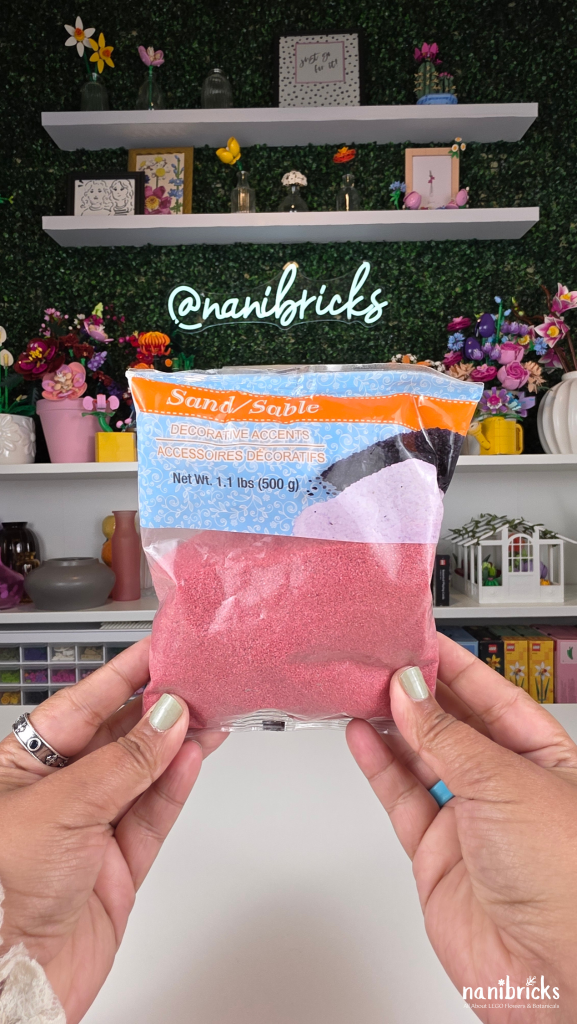
Decorative Sand
Decorative sand can also work well for LEGO flower displays.
It helps stabilize stems, looks attractive in clear containers, and doesn’t break down the way floral foam does. Because the sand shifts naturally, you can reposition flowers without creating permanent holes.
That said, sand can still be messy. Fine particles may get inside hollow LEGO stems, so I would avoid very dusty sand and use it primarily for arrangements that won’t be adjusted constantly.
Spare LEGO Pieces
Some builders use extra LEGO bricks and elements inside containers to help anchor stems.
It’s not always the prettiest solution, but it works surprisingly well in opaque pots or planters where the filler won’t be visible.
Plus, it’s hard to get more LEGO-friendly than using actual LEGO pieces.

Craft Foam
Craft foam is another option some collectors use inside opaque pots and planters. It’s lightweight, inexpensive, and creates far less mess than floral foam.
While repeated adjustments can eventually enlarge the holes, craft foam doesn’t crumble the way floral foam does and works well for semi-permanent LEGO Botanicals arrangements.

Which Method Is Best?
For most LEGO Botanicals collectors, I would recommend:
- Chicken wire – Best overall flexibility and support
- Tape grid – Simple, inexpensive, reusable, and effective
- Glass flower frog – Great for precise stem placement
- Decorative pebbles or marbles – Adds weight and stability
- Decorative vase fillers – Support stems while enhancing the display
- Decorative sand – Useful for finished displays but can be messy
- Spare LEGO pieces – A creative all-LEGO solution
- Craft foam – Good for opaque containers and semi-permanent displays
Personally, I use a combination of chicken wire and a tape grid for most of my arrangements. They’re reusable, easy to adjust, and work much better for my style of constantly rearranging flowers than floral foam ever did.
They give me the flexibility to experiment with new LEGO flower arrangement ideas without creating permanent holes, dealing with foam debris, or worrying about potential stem damage.
Should You Remove Floral Foam Immediately?
If your LEGO Botanicals are currently sitting in floral foam, I wouldn’t panic.
Most of the reports shared by collectors involve arrangements that remained in floral foam for long periods of time, often months or even years. Not every collector who has used floral foam has reported damage, and LEGO has not released an official statement confirming a direct chemical reaction.
That said, if your flowers are still sitting in floral foam, I do think it’s worth considering a switch.
Even if stem damage turns out to be less common than some collectors fear, floral foam still has several drawbacks for LEGO flower arrangements:
- It creates permanent holes when stems are moved
- Foam particles can become trapped inside LEGO stems
- Rearranging flowers becomes harder over time
- The foam gradually loses its ability to support stems
- It isn’t a reusable long-term solution
For collectors who enjoy creating custom arrangements, testing new recipes, or frequently changing displays, those issues alone may be enough reason to move to a different support method.
Personally, if I discovered one of my arrangements sitting in floral foam today, I would remove the flowers, inspect the stems, clean away any foam residue, and switch to a reusable support system like chicken wire, a tape grid, or a flower frog.
Those methods are cleaner, easier to work with, and make rearranging flowers much more enjoyable.
The good news is that LEGO flowers are surprisingly durable when displayed properly. Most collectors who switch away from floral foam never look back because the alternatives often provide better support while giving you more flexibility to experiment with your arrangements.
At the end of the day, LEGO Botanicals are meant to be displayed, rearranged, and enjoyed. Using a reusable support method simply makes that process easier and helps keep your flowers looking their best for years to come.
Frequently Asked Questions
Does floral foam damage LEGO Botanicals?
Some LEGO collectors have reported stem damage after long-term contact with floral foam. While LEGO has not released an official statement, many builders choose alternative display methods to avoid the risk.
Is wet floral foam or dry floral foam safer for LEGO flowers?
There isn’t enough evidence to know for sure. Most community reports involve green wet floral foam, but many collectors avoid both types for long-term LEGO displays.
What is the best alternative to floral foam for LEGO Botanicals?
Chicken wire and tape grids are two of the most popular alternatives because they’re reusable, adjustable, and work well for custom LEGO flower arrangements.
Can I use floral foam for a temporary LEGO flower display?
Probably. Most reported issues involve flowers left in floral foam for months or years rather than short-term displays.
Why doesn’t floral foam work well for LEGO flower arrangements?
Floral foam creates permanent holes, sheds debris, traps particles inside stems, and becomes less stable as flowers are rearranged.
How do collectors display LEGO Botanicals without floral foam?
Popular alternatives include chicken wire, tape grids, flower frogs, decorative pebbles, marbles, sand, vase fillers, and spare LEGO pieces.
Should I remove floral foam from my LEGO flowers?
You don’t need to panic, but many collectors choose to switch to reusable support methods, especially for long-term displays.
What do you use for your LEGO flower arrangements?
I mainly use chicken wire and a tape grid because they’re reusable, flexible, and make rearranging flowers much easier.
Can decorative sand be used with LEGO Botanicals?
Yes. Decorative sand can stabilize stems and look attractive in clear containers, though it may be messy if you rearrange flowers often.
What is the easiest LEGO Botanicals display method for beginners?
A tape grid is one of the easiest methods. It’s inexpensive, quick to set up, and works well for many LEGO flower arrangements.
Final Thoughts
After researching the community reports and trying floral foam myself, I personally won’t be using it for LEGO Botanicals again.
The potential stem damage is concerning, but honestly, I disliked floral foam long before I learned about the reports. It was messy, shed sandy particles everywhere, got stuck inside the stems, and made rearranging flowers frustrating. Every time I moved a flower, the foam created a permanent hole, which meant the arrangement became less stable over time instead of more stable.
For collectors who build a bouquet once and never touch it again, that may not be a dealbreaker.
But if you’re anything like me and constantly experimenting with LEGO flower arrangements, floral foam quickly becomes more annoying than helpful.
Even if floral foam turns out to be completely harmless, I still wouldn’t recommend it for most LEGO Botanicals displays because reusable methods like chicken wire and tape grids are cleaner, easier to adjust, and last much longer.
The good news is that there are plenty of alternatives that work just as well, or better. Chicken wire, tape grids, flower frogs, decorative fillers, sand, and even spare LEGO pieces can provide support without the mess, waste, or concerns that come with floral foam.
The biggest takeaway is simple:
There are enough community reports that it’s probably worth being cautious.
Even if the exact cause of the reported damage isn’t fully understood, there are safer, reusable display methods available that make arranging LEGO flowers easier anyway.
If you’re looking for better ways to display your bouquets, you might also enjoy:
👉 6 LEGO Botanicals Display Ideas That Actually Look Good at Home
And if you’re interested in building your own custom arrangements, check out my growing collection of LEGO flower recipes and arrangement tutorials.
At the end of the day, LEGO Botanicals are meant to be displayed, rearranged, and enjoyed. Finding the right support method simply helps keep them looking their best for years to come.
Before You Go
If you’re building custom LEGO flower arrangements, the support method you choose can make a bigger difference than you might think.
I learned that pretty quickly once I started experimenting with different bouquet recipes. The easier it is to move stems, adjust placement, and rebuild arrangements, the more enjoyable the entire process becomes.
That’s one of the reasons I switched away from floral foam and started using reusable methods like chicken wire and tape grids instead.
If you’re collecting LEGO Botanicals, creating custom arrangements, or planning future displays, keeping track of your sets can help too.
👉 Grab my free LEGO Botanicals Tracker here
It makes it easier to organize your collection, plan new arrangements, and keep an eye on upcoming and retiring sets before they disappear from your wishlist.